Transverse Flux Motor Brings Performance Improvements to Airless Paint Sprayer
Key Highlights
- Graco evaluated different electric motor technologies when developing its newest airless paint sprayers to overcome challenges with the conventional DC motors traditionally used in its sprayers.
- The company chose to use transverse flux motor technology from its ETM division because of the high torque capabilities it offered that would meet its sprayer’s performance requirements.
- Use of the transverse flux motor brought several other benefits as well while also addressing many of the challenges associated with DC motors and is now being considered for other sprayer models.
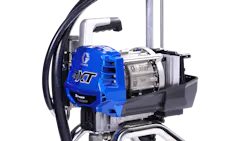
When it came time for Graco to develop the next generation of its airless paint sprayers, the company wanted to address challenges it faced with some of the components used in these devices, namely brushless DC motors.
Graco has traditionally used brushless DC motors in its sprayers to provide the high-pressure paint delivery its customers require for their professional painting applications. However, conventional DC motor technology also requires the use of a gear train to achieve the torque necessary for delivering paint at the pressures desired.
This adds design and mechanical complexity, increased noise levels as well as limited precision for pressure control — all aspects the company wanted to address.
“The real challenge was achieving high torque at low speeds without the heat, vibration, and mechanical complexity that comes with traditional motor designs,” said Jarrod Drexler, Senior Engineer, Graco Contractor Division.
So, the company began to evaluate its electric motor options and landed on transverse flux motor technology from ETM — the electric motor technology division of Graco Inc. — for its newest airless sprayer.
A transverse flux motor differs from other electric motor technologies in that its magnetic flux travels in a transverse direction to the axis of rotation of the motor. These motors are known for their high torque capabilities and compact design which can benefit many applications like paint sprayers.
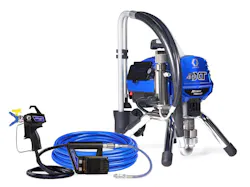
The Benefits of Using a Transverse Flux Motor in a Paint Sprayer
For its new XT Sprayer, Graco developed a motor specifically for the unit, and other airless sprayers, known as the Xtreme Torque (XT) Motor. The ETM transverse flux motor technology is integrated into the XT Motor to enable direct drive to the sprayer’s piston pump with no gear reduction required.
Drexler told Power & Motion that when Graco came across ETM’s transverse flux motor (TFM), “we initially were pretty excited that we potentially found a motor that could allow us to have the torque capabilities to reduce, or in some cases completely remove, the gearboxes that we had in our sprayers.”
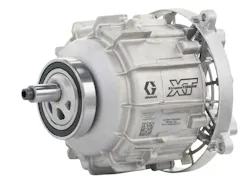
This enables the company to reduce part count, simplify the assembly, eliminate potential failure points and make the sprayer more durable. He said for some sprayer models, “it even allowed us to improve the maximum performance of the equivalent model to the previous generation.”
Drexler explained that the piston pumps in Graco’s airless sprayers are all typically crank driven. It’s a crankshaft that works similar to an engine in that it reciprocates up and down to convert rotary motion to linear motion for the piston pumps.
By using the ETM motor and eliminating the need for a gearbox, he said the motor can now run at a much closer speed to what the pump runs at. “That really allows us to make much quicker decisions in our controls of the sprayer, we can react faster; the sprayer is more responsive, so we get better pressure control and a tighter deadband on it,” said Drexler.
“We can accelerate the pump faster. We can brake it quicker if we need to,” he continued. “All of those things are really what made this motor very desirable to Graco for our sprayers.”
Noise reduction is another benefit the company found the TFM technology brought to its sprayers.
Drexler said its previous motor technology would typically run 4,000-6,000 rpm through a gear train, creating a lot of noise and whining through the gears. “By eliminating the gears completely, we went from almost having to yell over the sprayer to being able to just have a normal conversation standing right next to it.”
In the case of Graco’s largest XT motor, he said those are displacing air motor systems which can be extremely loud but are now almost whisper quiet.
The other benefit Graco has noticed with the TFM motor technology is the ability to accelerate and decelerate faster. Because the motor is not spinning as fast and there are not all the gears and extra mass typical with previous systems, “the total inertia in the system is much lower, by orders of magnitude,” said Drexler. The system can react quickly “if you don't have all that inertia and momentum built up into it.”
More Sprayer Options Using Transverse Flux Motors are in the Works
After seeing the benefits the TFM technology brought to its XT Sprayer, Drexler said Graco is evaluating its potential use in all of the company’s paint sprayers.
While it may not be able to be used in all of them due to costs, in general there is potential to do so because most of the pumps used in the company’s paint sprayers are relatively low speed pumps he said — lower operating speeds are where this motor technology is best suited.
He said the XT Motor Graco developed has since been used in two additional new sprayers which are the most powerful the company has designed to date. Its sprayers typically operate up to 3,000 psi but the new models with the TFM technology are close to 7,000 psi.
“It really combats traditional gas and hydraulic systems from a performance standpoint, and that’s a category of product that never existed before we used these motors,” he concluded.
About the Author
 Sara Jensen
Sara Jensen
Executive Editor, Power & Motion
Sara Jensen is executive editor of Power & Motion, directing expanded coverage into the modern fluid power space, as well as mechatronic and smart technologies. She has over 15 years of publishing experience. Prior to Power & Motion she spent 11 years with a trade publication for engineers of heavy-duty equipment, the last 3 of which were as the editor and brand lead. Over the course of her time in the B2B industry, Sara has gained an extensive knowledge of various heavy-duty equipment industries — including construction, agriculture, mining and on-road trucks —along with the systems and market trends which impact them such as fluid power and electronic motion control technologies.
You can follow Sara and Power & Motion via the following social media handles:
X (formerly Twitter): @TechnlgyEditor and @PowerMotionTech
LinkedIn: @SaraJensen and @Power&Motion
Facebook: @PowerMotionTech